Blog

  • Intervention Experiment

    Revenge Bedtime Procrastination——Intervention Experiment(Borrowed Time Experiment)

    Introduction:

    Experimental objective:

    If the “compensation for staying up late” time is shifted from late at night to the daytime, will the same length of “controllable time” still bring satisfaction?It shifts intentional “me time” from late night hours to a designated daytime window, testing whether time control and emotional satisfaction can still be achieved without staying up late.

    The goal is not to eliminate late-night behavior entirely, but to increase awareness of personal behavioral patterns around sleep and autonomy.

    如果将“熬夜补偿”时间从深夜转移至白天,同样长度的“可控时间”是否仍然带来满足?它将有意识的“自我时间”从深夜转移到指定的白天窗口,测试在不熬夜的情况下是否仍然可以实现时间控制和情感满足。实验目标不是完全消除深夜行为,而是提高人们对睡眠和自主行为模式的认识。

    Daily Schedule:

    Step1——Track your sleep and sense of control over your time记录你的睡眠和时间控制感

    Step2——Fill out a brief reflection diary (morning and evening)填写一个简短的反思日记(早上和晚上)

    Step3——Each day, you will: Maintain a fixed sleep from 24:00 to 03:00. Use daytime slot (e.g., 14:00–16:00 or 16:00–18:00) to engage in any activity of your choice(Watching short videos/TV series/daydreaming and so on ,do the things you usually do when you stay up late) 每天,你将:从24:00到03:00保持固定睡眠。利用白天时段(如14:00-16:00或16:00-18:00)从事任何你选择的活动(看短视频/电视剧/发呆等等,做你通常在熬夜时做的事情)

    Step4——Interviews after participating in the experiment参与实验后采访

    1.Sleep & Rhythm Tracker

    DateBedtimeWaketimeSleep Quality (1–10)Control Over Time (1–10)


    2.Daily Reflection Diary:

    Bedtime Record:

    -Which part of today feels the most “yours”?今天的哪一部分感觉最“属于你”?

    -Do you think you can control your time today?你觉得今天能控制自己的时间吗?

    – What time do you go to bed? What were you doing at that time? Feeling: Satisfaction/Anxiety/freedom /?你几点入睡?你当时在做什么?感觉:满足 / 焦虑 / 自由 / ?

    Morning Record:

    – What time do you get up?你几点起床

    -How did you feel when you woke up?醒来时感觉如何

    -Are you deliberately delaying your bedtime? Why?你是故意拖延睡觉时间的吗?为什么?

    3.Post-Experiment Survey:

    -Have you gained a sense of satisfaction after this “controllable period of time”?这段“可控时间”后,你是否有获得满足感?

    -Do you have the urge to keep delaying going to bed at night?你有想继续拖延晚上睡觉的冲动吗?

    -Do you think this way of “stealing time during the day” is more free or less boring than staying up late at night?你觉得这种“白天偷时间”的方式比深夜更自由还是更无趣?
  • weekly post6.10-6.15

    6.9 Tutorial notes

    Intervention – The negative factors are where the solution lies

    The opposite blog: What are challenges and obstacles – employer,money,health

    Interview the boss to prove your understanding of the problem instead of solving it.——Both the good and the bad need to be understood

    Intervention:before&after, evidence is still needed for intervention, such as questionnaires and interviews.

    Intervention include the knowledge of others &your knowledge.

    The difference between your knowledge and that of others, if there is no intervention, is only the knowledge of others.

    Next step: schedule of summer  

    Intervention test – stakeholder driven, feedback based on users, test intervention

    Intervention content – e.g. Daytime schedule, late-night activities, autonomy

    research strategy: Ethnography

    The introduction in the report can write the definition of Revenge Bedtime Procrastination and the research strategy is How.

    The “opposite side” may include:

    1. People who never stay up late or actively refuse to do so

    2. People who think “Revenge Bedtime Procrastination” is an excuse

    3. People who support efficient time management and oppose “self-compensating behaviors”

    4. Groups such as teachers, employers and parents who have a critical attitude towards staying up late

    Interview Objective:

    1.Their cognition or misunderstanding of Revenge Bedtime Procrastination

    2. Their views on the phenomena of “autonomy”, “sense of loss of control” and “nighttime compensation”

    3. Do they have alternative coping mechanisms

    4. The negative consequences they consider to be brought about by Revenge Bedtime Procrastination

    Parent group

    Interview purpose: To explore the differences in the cognition of daily routines among generations in a family and how parents understand their children’s behavior of staying up late.

    1.Have you noticed that your child often stays up late? Do you think this is a norm or a problem?

    2. Do you understand the motivation behind “Revenge Bedtime Procrastination”? Do you think this is just an excuse?

      3. Have you ever tried to communicate with your child about their daily routine? How was the communication outcome?

      4. In your growing-up years, what kind of behavior was staying up late regarded as?

      5. If you could help your child change the habit of staying up late, where would you start?

      Employer/manager group

      Interview purpose: To understand whether the work pace and performance expectations are the reasons that affect young people’s late sleep, and explore possible intervention roles.

      1. Have you noticed that your subordinates or team members are experiencing symptoms such as insufficient sleep and fatigue?

      2. Do you think “Revenge Bedtime Procrastination” is a response to the compressed work pace or time?

        3. Do you support employees having more flexibility in their schedules?

        4. In your opinion, should organizations take responsibility for improving employees’ sense of time and psychological stress?

        5. If an intervention method that helps employees regulate their work and rest schedules could be introduced, would you support it? What characteristics do you expect it to have?

        Questionnaire(focus on specific groups of people)

        Part One: Behavioral Cognition

        1.How do you understand “Revenge Bedtime Procrastination”? Have you heard of this word?

        2. Have you ever had the experience of delaying falling asleep yourself? If so, what is the reason behind it? If not, why?

          3. Do you agree that “staying up late is to make up for the lack of freedom during the day”?

          Part Two: Attitude

          1.Some people voluntarily stay up late to “regain their own time”. What’s your opinion on this behavior?

          2. Do you think this is “procrastination” or “immature behavior”?

            3. Have you ever expressed dissatisfaction with your friends or colleagues who stay up late around you? Why?

            Part Three: Rhythm of Life

            1.How do you usually arrange your night time? Is there a regular schedule?

            2. How do you deal with it when you feel that your time is fully occupied or you are under a lot of pressure during the day?

              3. Have you ever experienced the stage of “having complete control over your own time”? What changes did that period of time bring?

              Part Four: Understanding or Suggestions

              1. If you were asked to offer advice or opinions on people who have been staying up late in a retaliatory manner for a long time, what would you do?

              2. What social factors do you think would magnify this phenomenon of “compensation for staying up late”?

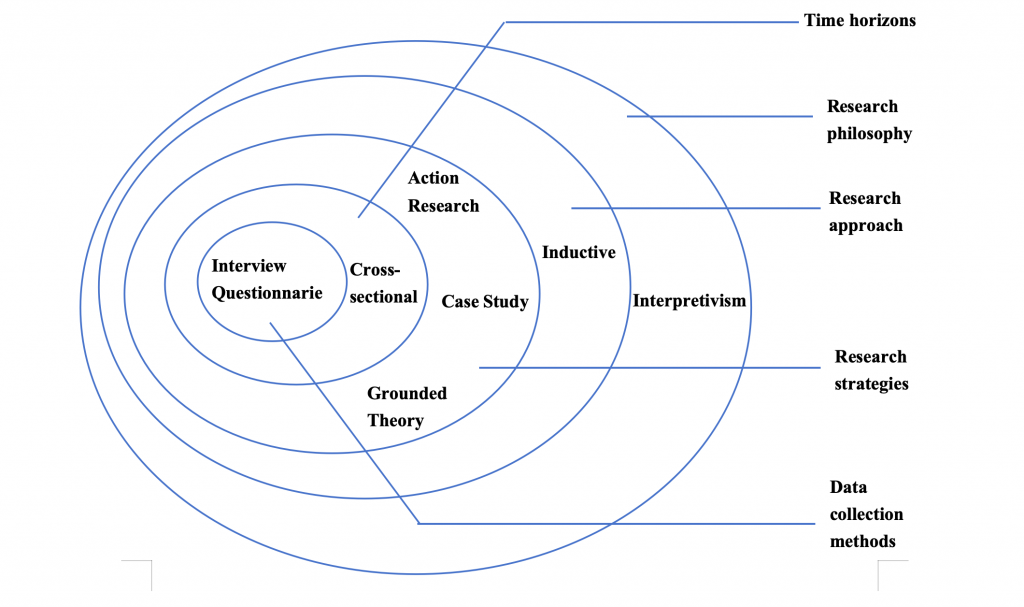
              1. Research Onion

                Research Philosophy

                Positivism:Believe in a single reality or truth. Good positivism will have a theory or hypothesis that can be tested by numbers.

                Interpretivism: It is not interested in numbers or averages, but is more interested in the possible nuances in multiple realities that may exist. Be more interested in viewpoints and experiences, and admit one’s subjectivity as a researcher.

                Research Approach

                Inductive:When consulting the literature, it was realized that the research question and the theoretical materials behind it were not abundant.By using induction, the collected data will create theories for you. Using these data, group the research elements – the data will create theories.

                Deductive: Use data to test theories, not to create them.

                Qulitative:focus on text、image or video-based data sources.

                Quantitative: focus on numerical/quantitative data

                lack of existing literature——Inductive

                focused on human experience——Qulitative

                Research Strategy

                experimental research:control group/test group,focus oncompare

                descriptive research:a larger population of interest

                action research:benefit the respondents in the sample

                Grounded theory:building a theory based largely on the collected data.

                first – interview. Recall the patterns in the interview and design theories based on these patterns

                second – Whether it is applicable to another group

                case study research

                Time Horizon

                Cross-sectional:Focus on a certain period of time

                Longitudinal: How do things change over time at different points in time

                LayerResearch Design
                Research PhilosophyInterpretivism——My research aims to understand why individuals choose to delay going to bed even when they know that staying up late is harmful. This is a subjective and emotion-driven behavior. What I focus on are the emotions, motivations, life rhythms and psychological states behind the behaviors, with the goal of understanding why young people actively choose to stay up late. 
                Research ApproachInductive——I have summarized the problems from my own and the target group’s experiences of staying up late, and learned about the phenomenon of Revenge Bedtime Procrastination from real life, rather than verifying hypotheses based on theories. Through data such as observation, questionnaires and interviews, I constructed an understanding of the mechanism of ” Revenge Bedtime Procrastination” and generated my own intervention model.  
                Research StrategyAction Research: 
                Test feedback through intervention
                Case Study: 
                Focusing on specific groups (college students and young workers), it deeply understands the background and impact of their staying up late behavior.
                Grounded Theory: Continuously analyze behaviors and emotions in data collection to form a theoretical framework.——The feeling of being occupied during the day → procrastination at night → sleep deprivation → fatigue the next day → forms an anxiety cycle. 
                Time HorizonCross-sectional 
                Methodological ChoiceMono Method – Qualitative focus using interviews and observations.
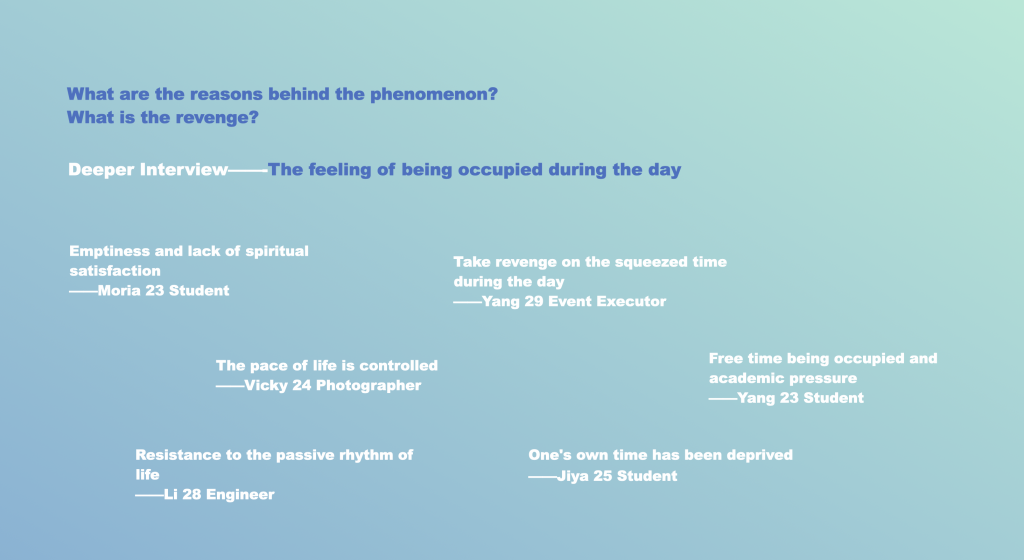
                Data Collection Methods Interviews:who had Revenge Bedtime Procrastination behaviors, with the aim of understanding the reasons behind the phenomenon and what the revenge is.
                Questionnaire:The intention is to understand the respondents’ cognition, impact and attitude towards Revenge Bedtime Procrastination.

                Research Question

                How can behaviour created by a loss of autonomy over work-life balance be mitigated, help Chinese young people not seek late-night activities, as compensation for loss of agency in their daytime schedules?

                How can behaviour created by a loss of autonomy over work-life balance be mitigated——research objective,what needs to be changed

                help Chinese young people——who is affected

                not seek late-night activities——Phenomenon

                as compensation for loss of agency in their daytime schedules——why it happens,Indicate the underlying behavioral logic

              2. unit 3

                Tutorial-5.27

                1.Blog content: Reflection

                2.Formulate the next research plan

                The purpose of research——Research has evolved from assumptions and ignorance. For insight and understanding.

                The focus of the research is to transform data into knowledge. Do not concentrate on solving problems,develop the ability to understand through research

                Blog——It needs to cover my own reflection, knowledge, and communication, not just data. It is also necessary to provide my own interpretation and understanding of the data. Understanding——testing, verification——a solid foundation

                It needs to be sorted out according to the timeline, and miro can serve as an aid.

                Redefine (how to improve) my question – point out the situation in the question. If it is a specific group, where were these people found, who are they, what kind of work are they doing, and what type of work can be pointed out(Based on the conclusions of my questionnaire survey and interview research).

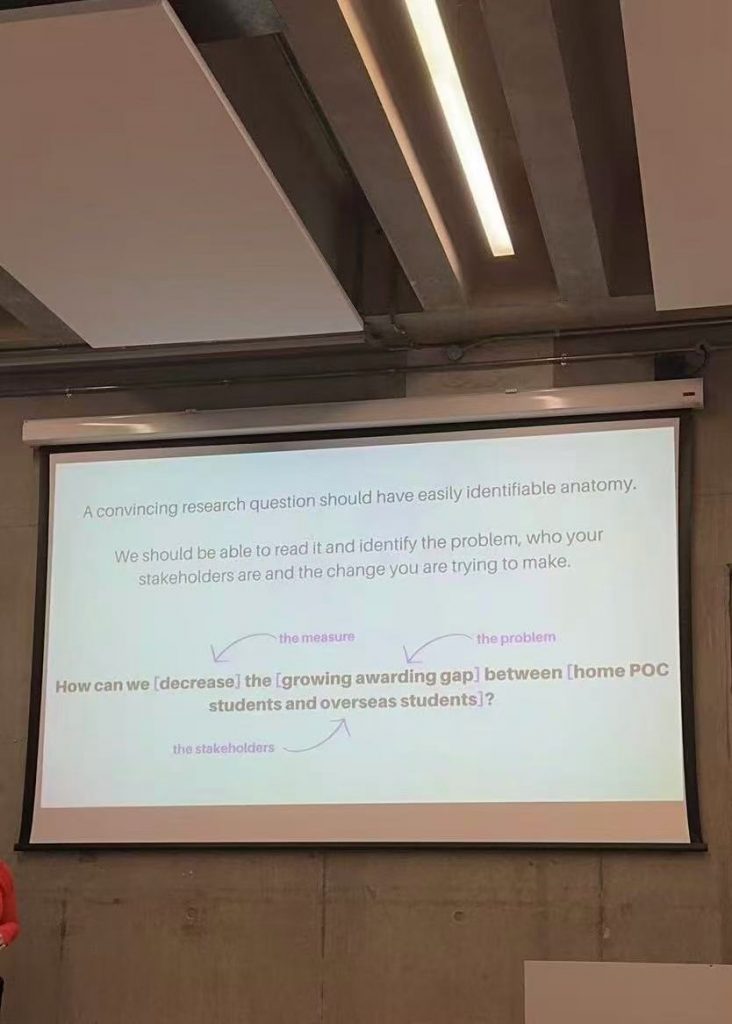
                Question:

                The measure: What do you want to do? (Reduce/Improve/Enhance/redefine)

                The problem: What phenomenon or predicament is it?

                The stakeholders: Who are you concerned about? Who is affected?

                The feeling of being occupied during the day → procrastination at night → sleep deprivation → fatigue the next day → forms an anxiety cycle.

                interview:https://miro.com/app/board/uXjVIDTw3Jg=/?moveToWidget=3458764628664254516&cot=14

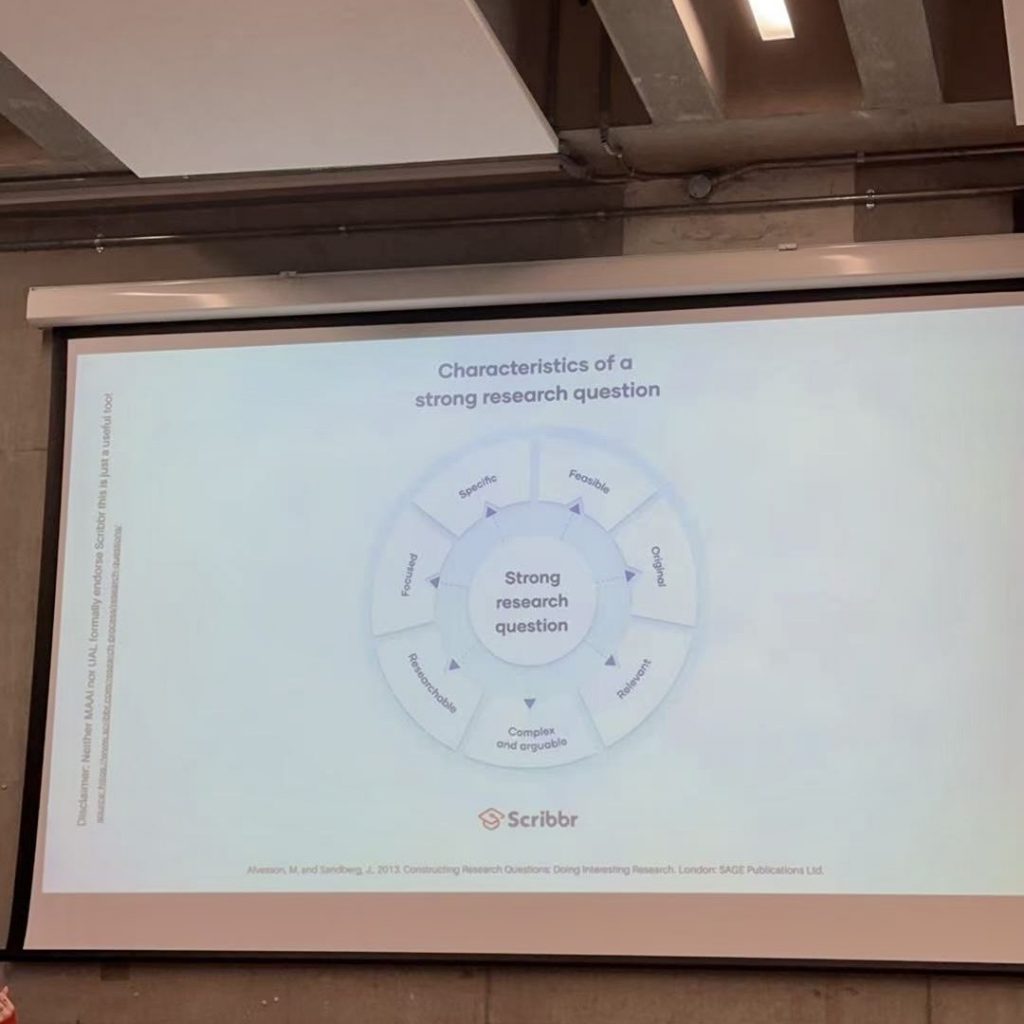
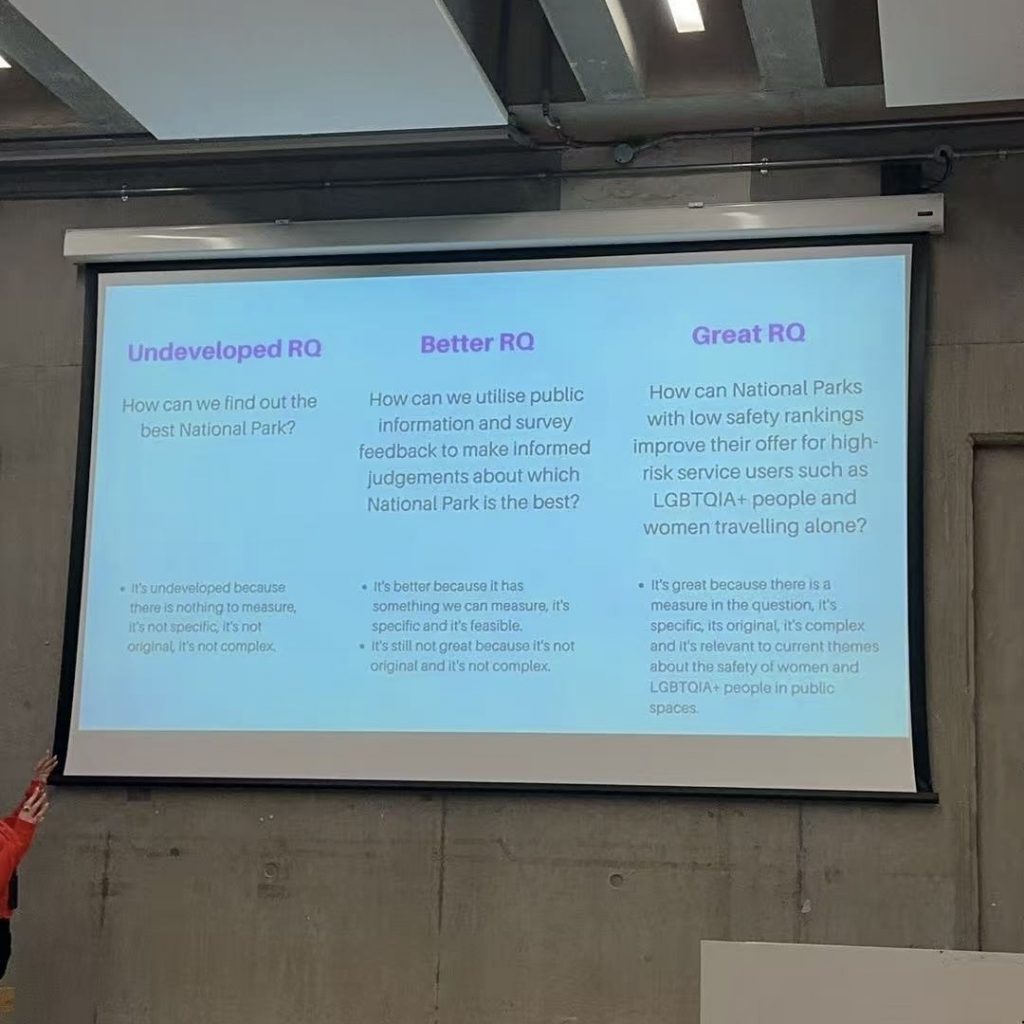
                How can we reduce revenge bedtime procrastination by addressing daytime time deprivation and anxiety among young people?

                the measure:reduce revenge bedtime procrastination

                the problem:daytime time deprivation and anxiety

                the stakeholders:young people

                Behavior:

                How can we redesign daily rhythms to reduce the need for revenge bedtime procrastination among time-deprived youth?
                How can we reduce revenge bedtime procrastination by addressing young people’s loss of control over daytime hours?

                Psychology and emotion:

                How can we help young people regain emotional balance and time autonomy to reduce revenge bedtime procrastination?

                 How can creative intervention help anxious and time-deprived young people find healthier compensation methods than Rrevenge Bedtime Procrastination?  

                Next step:

                1.Fixed-point population survey——Select a specific group (Young people in the design industry or graduate student )

                2.Obtain their daily plans and motivations for staying up late through questionnaires/interviews

                Motivation (Focus on one of them) :emotional compensation、perceived time ownership、digital overstimulation

                3.Test my initial intervention assumption: the form of music therapy